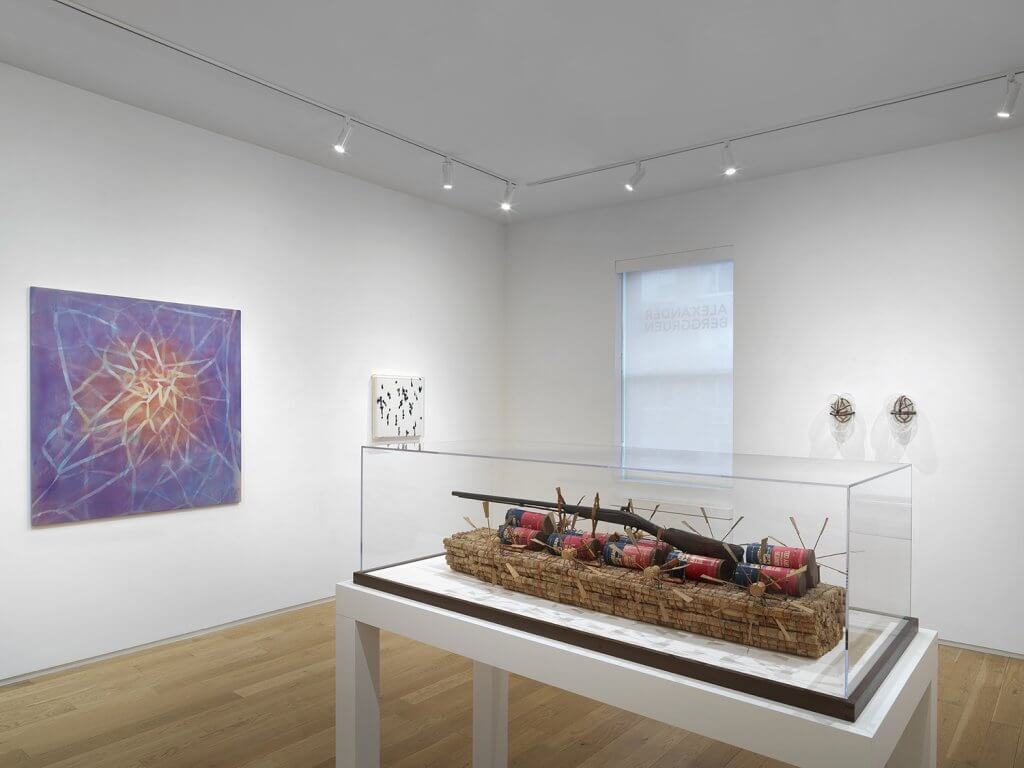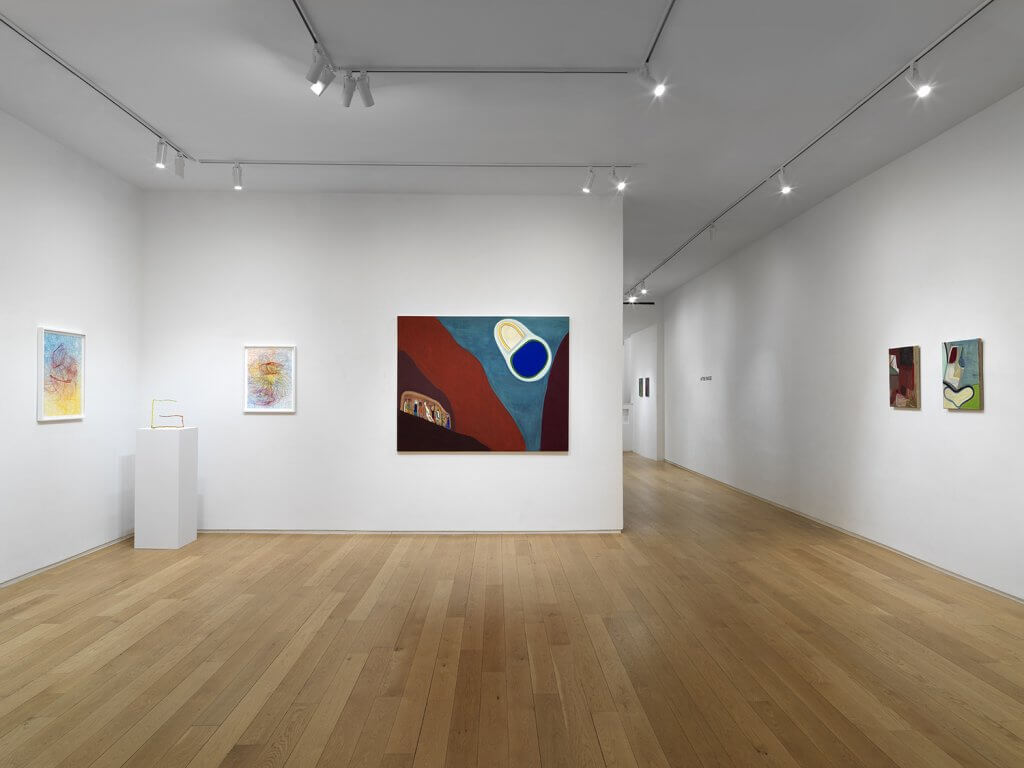
Installation view of After Image (December 10, 2025-January 14, 2026) at Alexander Berggruen, New York.
On the occasion of our exhibition After Image (December 10, 2025-January 14, 2026), we spoke with select artists about their work.
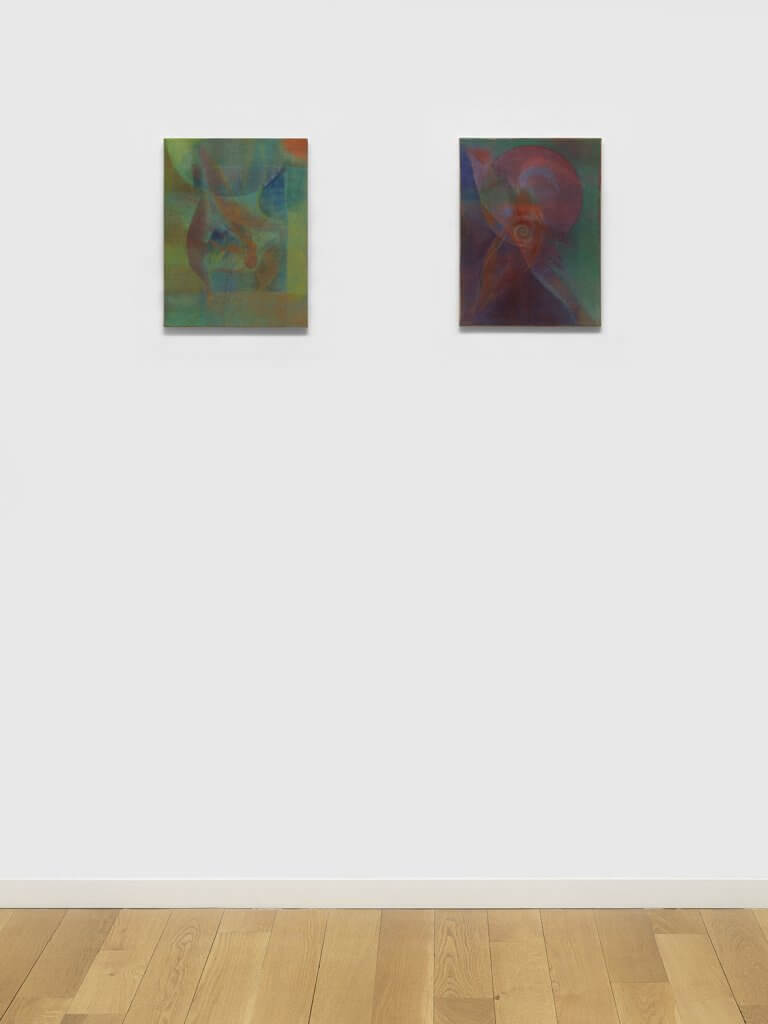
Installation view of Azadeh Elmizadeh’s work in After Image (December 10, 2025-January 14, 2026) at Alexander Berggruen, New York.
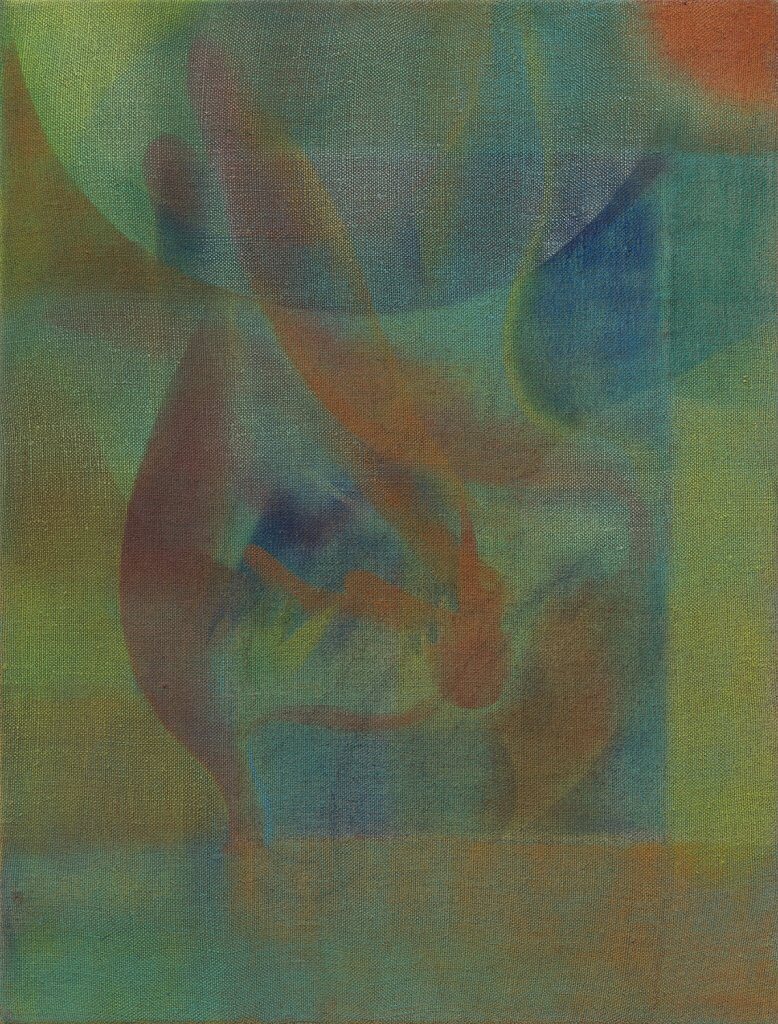
Q: The frame-like device forming an off-center rectangle in Green Veil seems to reveal a window to otherworldly imagery. How did these shapes emerge in this painting for you?
A: The frame-like structure in Green Veil emerged through working with successive washes of colour. Subtle vertical and horizontal shifts gradually asserted themselves, creating a loose sense of containment within the larger field. These boundaries remain soft and permeable, allowing colour and form to pass through rather than be held in place. This approach is informed by the spatial logic of Persian miniature painting, where space unfolds laterally and multiple moments and viewpoints coexist on a single surface. Rather than functioning as a literal window, the off-centre rectangle operates as a zone where density and atmosphere subtly shift. The forms within it feel suspended, caught mid-transition, suggesting an image that is simultaneously forming and dissolving.
Azadeh Elmizadeh
Green Veil, 2025
oil on linen
16 x 12 in. (40.6 x 30.5 cm.)
Courtesy the artist and Franz Kaka, Toronto.
Q: Would you like to discuss one other artwork in this group exhibition that you feel especially invites a conversation with your work?
A: In looking at the works of the other exhibiting artists online (I wish I could have seen them in person, as with painting, it makes a significant difference), I was drawn to Anna Kunz’s Into Shadow as a point of dialogue with Green Veil, particularly through its shared attention to layered space and reduced visibility. While Kunz’s painting introduces more defined structural elements, both works rely on transparency and overlapping colour to generate depth. In Green Veil, forms remain diffuse and atmospheric; in Into Shadow, they become more contained and architectural. I am interested in Kunz’s work for the way it suggests that perception often unfolds under conditions of partial obscurity, where meaning emerges slowly through lingering rather than through immediate recognition.

Installation view of Evan Holloway’s work in After Image (December 10, 2025-January 14, 2026) at Alexander Berggruen, New York.
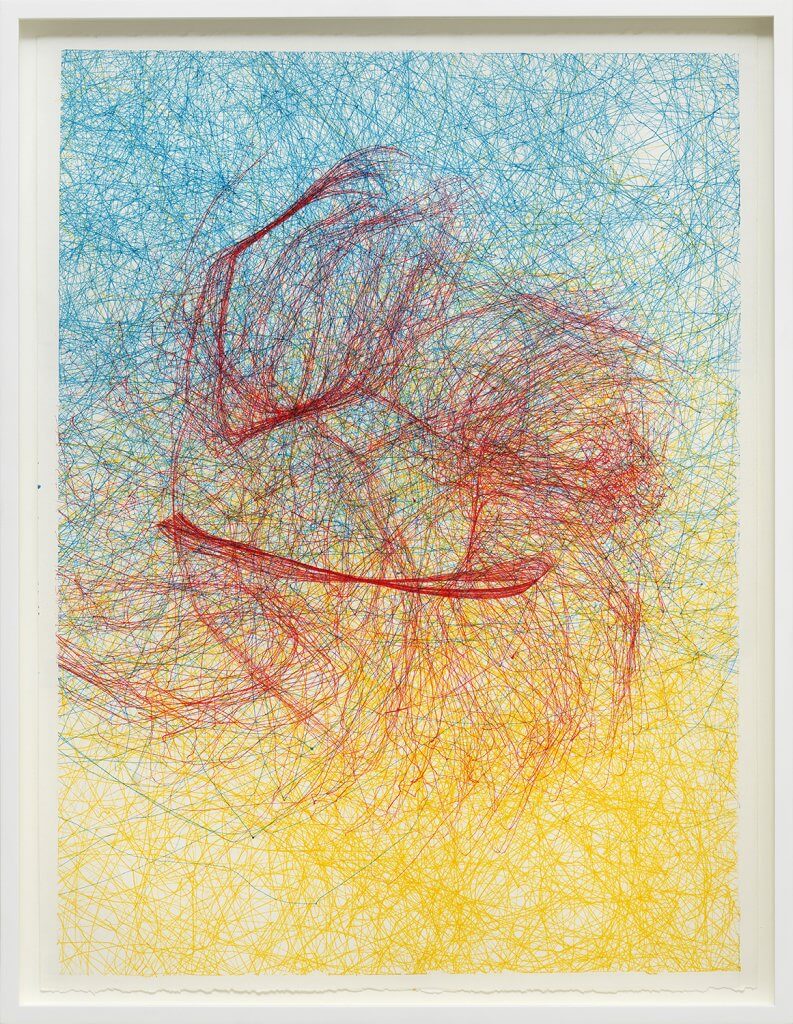
Q: The lines formed by your sculpture appear much more simplified than the lines formed by your Scry works on paper. What inspires your varied approaches to order and spontaneous mark making?
A: In both works, line records time. The Scry drawings accumulate slowly through hours of mark-making, while the branch sculptures follow the logic of tree growth—thicker where older, thinner at the tips. Line carries both duration and direction in these works, but with different intentions and results.
Evan Holloway
Scry #8, 2024
ink on paper
26 1/4 x 19 3/4 in. (66.7 x 50.2 cm.)
framed: 28 x 21 1/2 x 1 1/2 in. (71.1 x 54.6 x 3.8 cm.)
Courtesy of David Kordansky Gallery
Q: Would you like to discuss one other artwork in this group exhibition that you feel especially invites a conversation with your work?
A: Even through the limits of the screen, H. E. Morris’s work reads as open-ended and shaped by spontaneous decisions rather than predetermined forms. The question of when to stop feels central. That openness invites ambiguity and asks the viewer to project meaning into the work’s beginnings and endings—a shared territory between our practices in this exhibition.

Evan Holloway
One and Two, 2016
bronze, oil, and enamel
10 1/2 x 10 1/2 x 10 1/4 in. (26.7 x 26.7 x 26 cm.)
Courtesy of David Kordansky Gallery
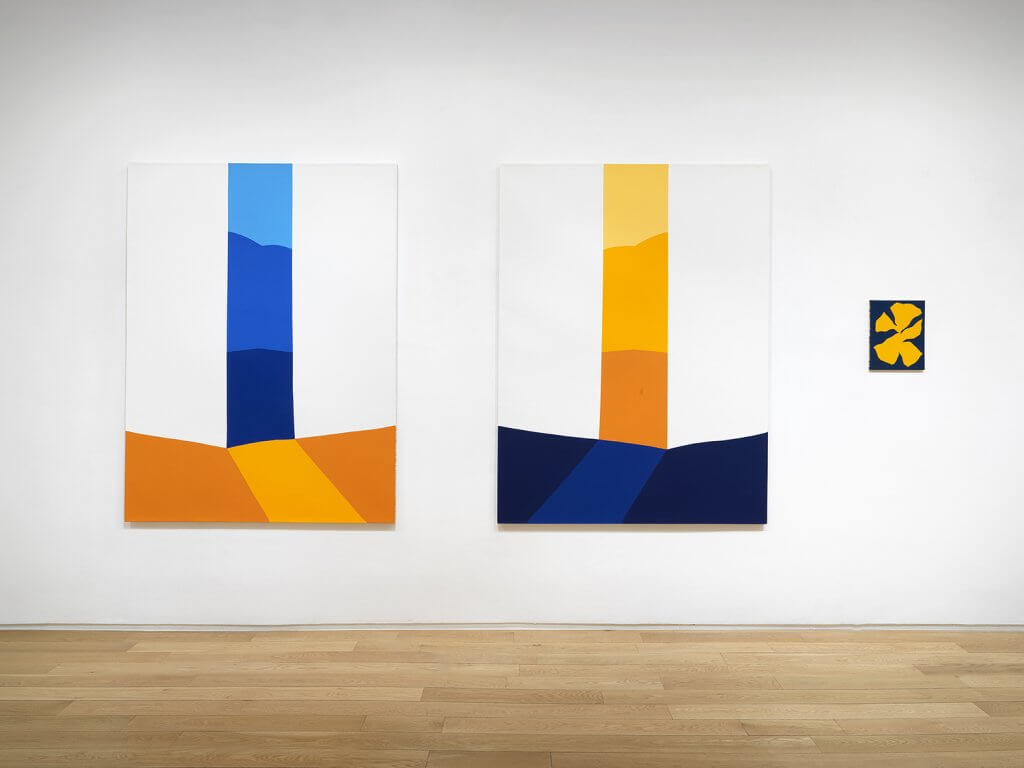
Installation view of Paul Kremer’s work in After Image (December 10, 2025-January 14, 2026) at Alexander Berggruen, New York.
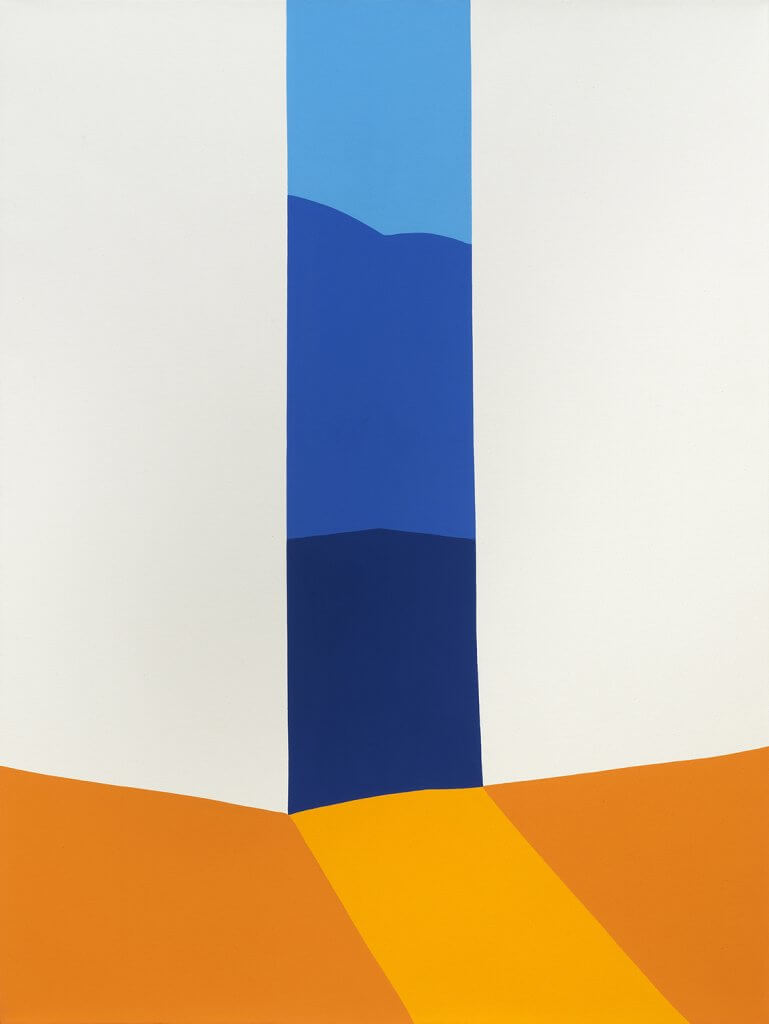
Q: Could you describe the inception of your Doors series?
A: The Doors series came about because I was curious to explore the idea of just a sliver of a landscape. Imagine being in a room and looking through a narrow doorway opening, seeing only the ground, the horizon, and the sky. Even just within that very limited framework or point of view, it is possible to observe nearly limitless displays of simplicity and beauty, and I wanted to capture some of what I thought the most captivating iterations of that beautiful simplicity might be in the Doors paintings.

Paul Kremer
Peel 08, 2024
acrylic on canvas
14 x 11 in. (35.6 x 27.9 cm.)
Q: Alongside one another, both your Doors and Peel series gesture towards ascension—the former by the beauty that lies beyond, and the latter with hints of birds in flight in the negative space. How do you think about the opportunities present in the oscillation between the negative and positive space within a composition?
A: What lies beyond, or out of sight, or even just outside of someone’s initial impressions of what they’re viewing (as with negative space) is a notion full of possibility. I am always building worlds within worlds to explore in my work, and within those worlds, I like to discover the countless beautiful moments that lie waiting to emerge. Moments of contrast where dark corners turn bright, for example, or where the hint of a static (or is it falling?), discarded orange peel makes way for the suggestion of life-affirming birds in flight. Within those moments are opportunities for reflection and complexity, as well as for positivity and hope. I feel like the concept of ascension captures some of that hope, whether as seen in the Doors, the Peels, or a series of my older works simply titled Ascends, and in each of them, the negative space is just as important to me as the positive space is. I like the way that color can transform what is generally perceived as “white space,” and I find it interesting to draw with negative space by repositioning positive shapes until the negative space creates something additional, like the beaks, heads, necks, and wings of birds in the Peels.
Paul Kremer
Doors 09, 2025
acrylic on canvas
72 x 54 in. (182.9 x 137.2 cm.)
Q: Would you like to discuss one other artwork in this group exhibition that you feel especially invites a conversation with your work?
A: Evan Holloway’s One and Two plays with space in a way that feels familiar to me. The sculpture shifts as you move around it, creating its own sense of front and back, inside and outside. That back-and-forth movement between object and space relates closely to how I think about my paintings, where I use the simplest form and color to try to create the feeling of depth, openness, or passage without illustrating a specific place.

Installation view of Anna Kunz’s work in After Image (December 10, 2025-January 14, 2026) at Alexander Berggruen, New York.
Q: Hung next to Alain Biltereyst’s paintings, the way your paintings cannot be contained within and seep outside of the rigid structure of a grid is emphasized. How do you think of the balance, or lack thereof, between order and spontaneity in your work?
A: The tension you’re describing is central to my practice, though I think of it less as a balance than as a productive instability! I do work with structure, my rectangular canvases are determined by my wingspan, and this gives me room for improvisation, working on multiple canvases simultaneously to create a conversation across the body of work. I’m committed to improvisation and chance and what emerges through the act of painting itself.
The watery washes I use literally refuse containment and can’t be controlled 100 percent. They create soft boundaries rather than hard edges. This isn’t accidental; I use a lot of water specifically because I want to dissolve hard-edged boundaries. Where Biltereyst mines the graphic precision of commercial imagery and transforms it into beautiful geometric meditation, I’m interested in how color can create structure through its own optical behavior rather than through imposed geometric order.
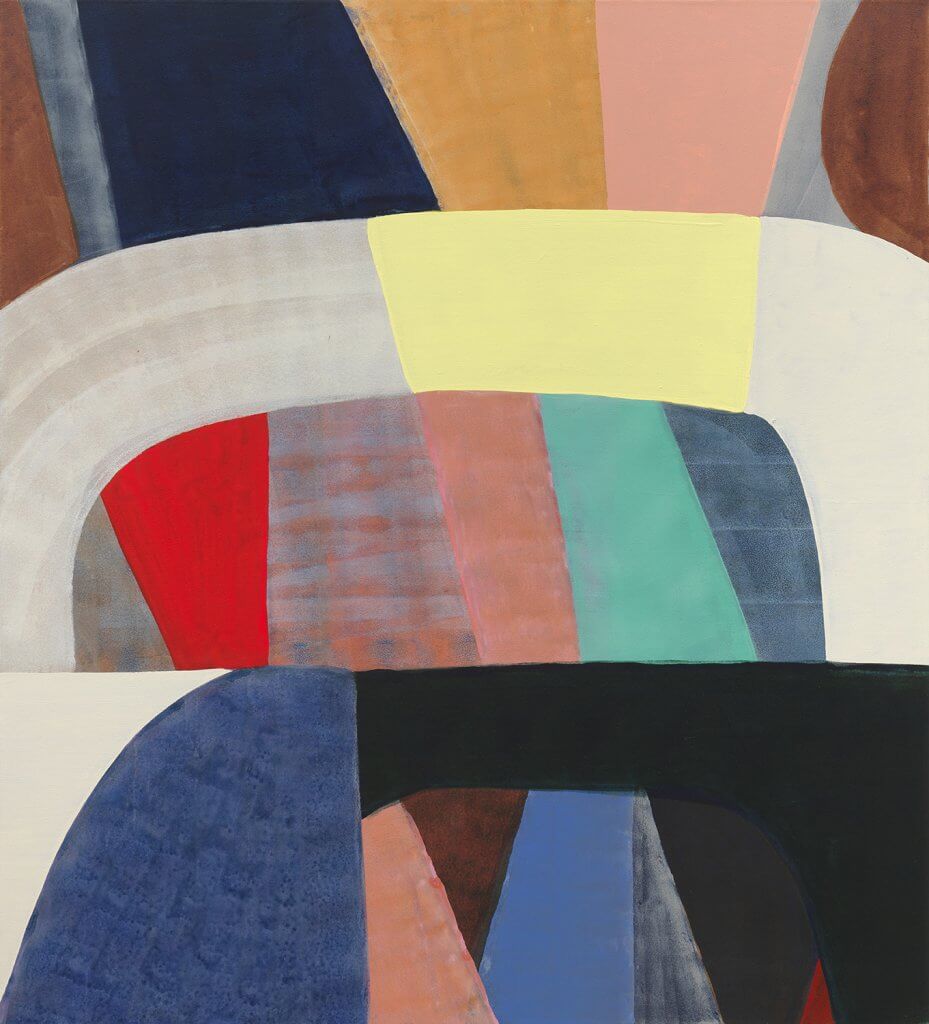
Anna Kunz
Beacon Over Overpass, 2024
acrylic on canvas
53 x 48 in. (134.6 x 121.9 cm.)
Q: Where does the title Beacon Over Overpass come from?
A: I often title works with found words and phrases from poetry and prose fragments that resonate with the perceptual or emotional experience the painting embodies. “Beacon Over Overpass” captured something about how light functions in these paintings as both a guide and a presence hovering above mundane infrastructure.
There’s a duality in that title that interests me: the beacon suggests something elevated, guiding, almost sacred, while the overpass is pure function, concrete, transit. It mirrors how I think about abstraction—finding something transcendent or transformative in immediate, embodied experience. The paintings aren’t about escape from the material world; they’re about heightened attention to what’s already present. Light moving through space. Color as both optical phenomenon and felt experience.
The title also suggests perspective, something watching over, providing orientation. My paintings work with optical progressions where colors extend out toward the viewer, they are invitations to experience, and I use the color to build space. The beacon isn’t fixed; it shifts depending on light, time, your position. Like an overpass, the paintings are thresholds—you move through the experience of looking at them.
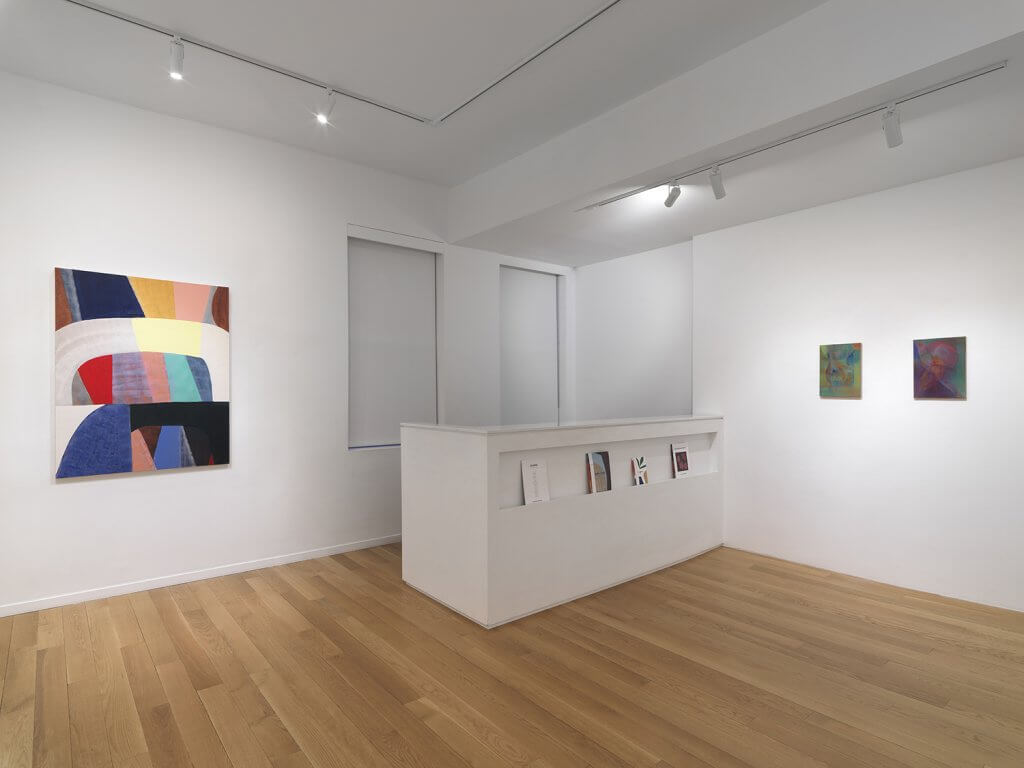
Installation view of After Image (December 10, 2025-January 14, 2026) at Alexander Berggruen, New York.
Q: Would you like to discuss one other artwork in this group exhibition that you feel especially invites a conversation with your work?
A: Azadeh Elmizadeh’s practice offers a counterpoint to mine, particularly in how we both use translucent layering to create atmospheric depth, but arrive from completely different conceptual frameworks. She works explicitly from ancient narratives, and her surfaces are also like palimpsests. She glazes oil with the patience of a miniaturist, slowly layering and then burnishing or sanding into the surface.
I’m working from a more phenomenological place—focused on color perception, on sensorial memory rather than specific cultural archives. Where Azadeh’s work excavates and reinterprets historical forms, mine operates in a more immediate register of bodily experience and optical phenomena.
But I think we share something important: a commitment to duration, both in making and viewing. Her process of layering oil glazes mirrors my practice of building through countless watery washes. Both of us create paintings that resist instant legibility and reward sustained attention. We’re both interested in liminal states that address transformation and threshold spaces, and rely on color’s inherent instability and contingency.
What’s particularly generative about seeing our work together is how it demonstrates that abstraction can serve multiple purposes simultaneously, suggesting that the current life of abstract painting comes from suggesting it as a capacious field that can contain embedded time, and accommodate both cultural excavation and perceptual investigation.
The ancient and sacred practice of painting can evoke contemporary concerns. That thought feels very timeless.
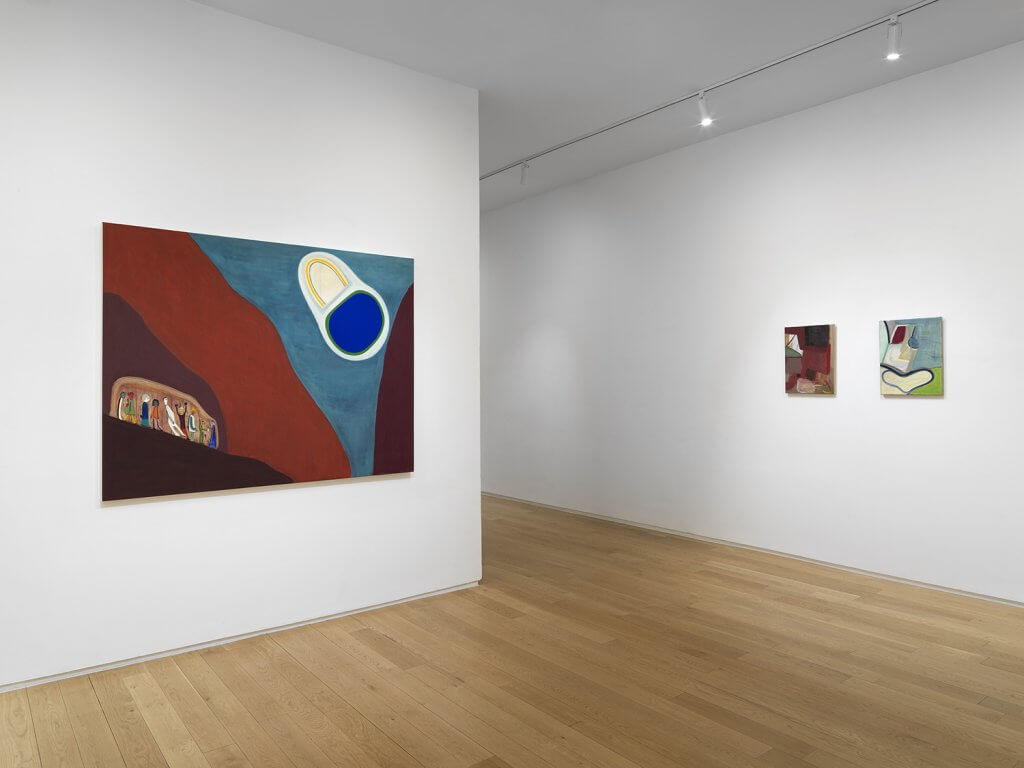
Installation view of Vicente Matte’s work in After Image (December 10, 2025-January 14, 2026) at Alexander Berggruen, New York.
Q: You stated that your small Untitled paintings are part of a recent series where you’re aiming to “preserve the face as a subject” while abstracting their forms. What is your process like in abstracting the face? Are these paintings based on real people?
A: It is a fairly intuitive process of construction and destruction, where frustration plays a fundamental role. It’s curious, because these faces are not based on real people, so there is no goal of capturing the essence of a particular character, which is so characteristic of the portrait genre. However, during the process of painting these works, I am completely absorbed by the ambition to ensure that the face I am painting, however abstract it may be, manages to have an existence of its own.
I have always felt a special interest in the spiritual force of pure forms, and I believe that in these paintings what I am seeking is for the pure forms not to conflict with the figuration of a face, but rather for both together to be directed toward that quest to achieve a painting that has its own existential and psychological force.

Installation view of Vicente Matte’s Untitled works in After Image (December 10, 2025-January 14, 2026) at Alexander Berggruen, New York.
Q: Would you like to discuss one other artwork in this group exhibition that you feel especially invites a conversation with your work?
A: I really admire all the artists in this group show. And I think there are many interesting relations that arise spontaneously between the works on display. I found it very interesting to see my work alongside that of Evan Holloway, whom I admire greatly. I love his sculptures! There is a very special intimacy in Holloway’s works; his small sculpture (One and Two, 2016) is as light as it is dense, as if that lightness were only a gateway to a much heavier and more contradictory world. And I find that paradox very stimulating, because I have always sought to hide, and I would say protect, the complexity of a painting behind simplicity.
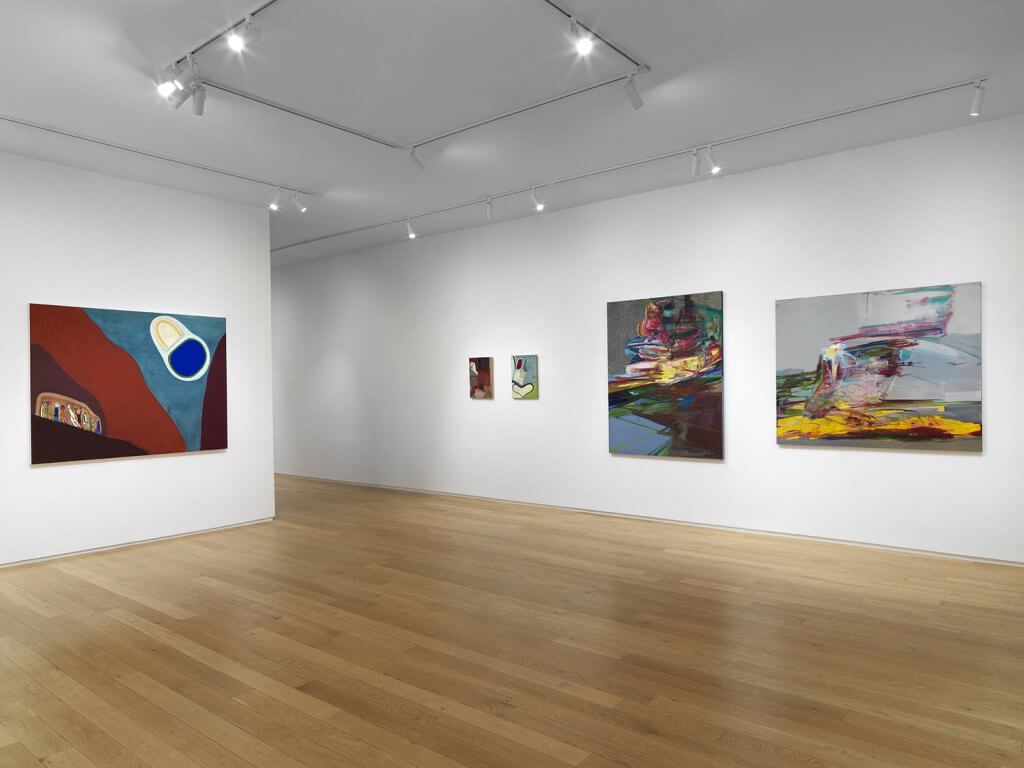
Installation view of After Image (December 10, 2025-January 14, 2026) at Alexander Berggruen, New York.
Q: In 2024, you received your PhD in Philosophy and Fine Art from Newcastle University—congratulations! How does your interest in philosophy inform your paintings, or your paintings inform your interest in philosophy?
A: Thank you. Philosophy and art theory are a big part of my practice and how I think of the language in the work evolving. In this respect, I am interested in the language of painting and how a narrative is developed by the artist, which in turn is read by the viewer and affects the viewer. As painting is often associated with the personal and subjective, painting offers the opportunity to question aspects of indexicality and agency. I enjoy thinking about my work through different themes such as how to define different emotional conceptions of touch, color and surface.

H.E. Morris
Fallen, 2025
oil on fabric
63 x 51 1/8 in. (160 x 130 cm.)
Courtesy of the artist and LBF Contemporary.
Q: The glittering fabric you stitch together to serve as your canvas lends your paintings a slippery quality. These overlapping fabrics create a shifting surface that induces areas of blur and dynamic perceptual movement, and they also lend the work a feminine quality. What are your thoughts on these associations?
A: The fabrics I use come from off ends of mysterious sources from high fashion to fast fashion and the reference with each piece of fabric changes the affect of the painting. The fabric interests me as it complicates the act of painting. It makes painting have higher stakes as every mark remains present, there is no erasure here. I do not associate a gender with this task as I often feel like a tailor when I am initially sewing the pieces together, which has been traditionally more of a masculine discipline. For me it’s more about color and texture and building a surface from which I can disrupt.

H.E. Morris
The stage, 2025
oil on canvas
51 1/8 x 63 in. (130 x 160 cm.)
Courtesy of the artist and LBF Contemporary.
Q: When speaking about your painting The Stage, you stated, “In The Stage, I was thinking of the after event and how we read a painting and the narratives that unfold within them.” What are some of the narratives you see unfolding within this painting?
A: I am interested in how different gestures and color can signify a meaning to the viewer. In the case of The Stage I was thinking about two things. One the repetition of images of war and the simulation of those events trying to hold on to what is real and true amongst the hyperreal and dissolution of a reality. The other is how to make a painting that holds both beauty and destruction, like the age old question of good and evil. I guess without evil we wouldn’t know what is good, so I am trying to play with that in the work.

H.E. Morris
Eclipse, 2025
oil on fabric
59 x 35 3/8 in. (150 x 90 cm.)
Courtesy of the artist and LBF Contemporary.
Q: Would you like to discuss one other artwork in this group exhibition that you feel especially invites a conversation with your work?
A: I really love Alain Biltereyst’s work, and it was really cool to be able to see them in person where the surface really changes. I think the way he plays with color and line lends particularly well to the ruptures he allows to happen in his work. The idea that the surface is much more complex than initially visually understood allows for the viewer to question what is really true in this work.

Installation view of After Image (December 10, 2025-January 14, 2026) at Alexander Berggruen, New York.
Artwork and Installation Photos: Dario Lasagni