By Simon Wu
June 2025
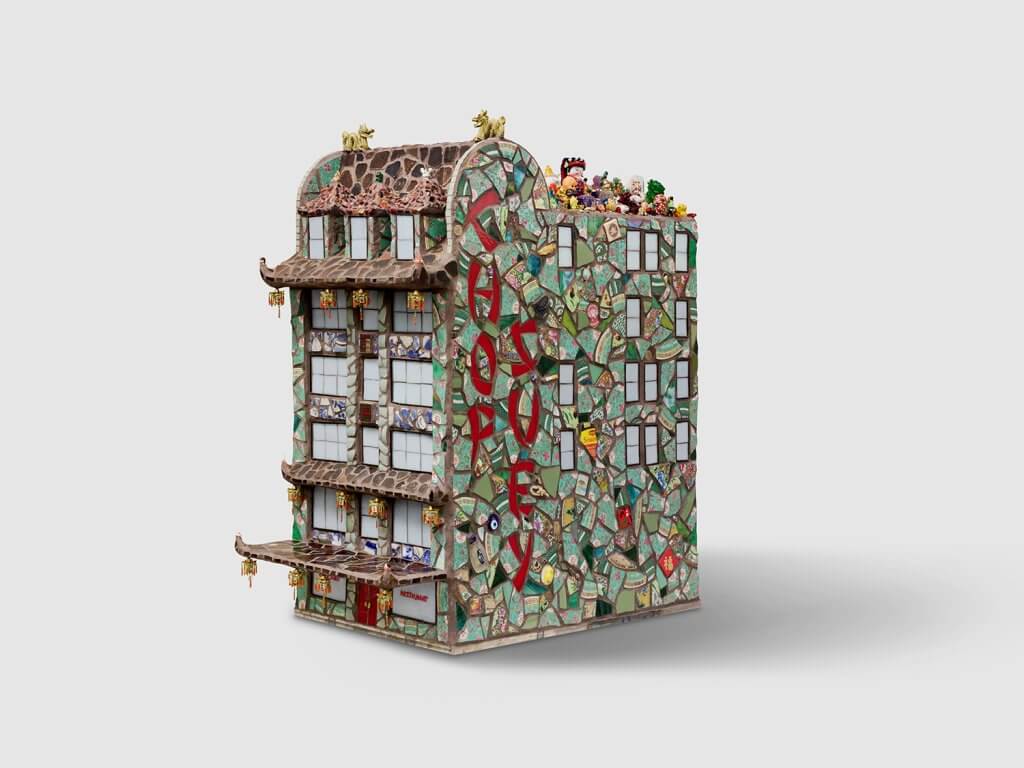
Stephanie H. Shih
Toy Building (Dream House), 2025
Chinese export porcelain, crowdsourced and found objects, archaeological ceramic fragments from a Chinese fishing village on Monterey Bay (c. 1850–1906), stained glass, polished stones, ceramic, glass rods, resin, enamel, and grout on ferrocement, polystyrene, and steel
51 x 25 x 45 in. (129.5 x 63.5 x 114.3 cm.)
Photo: Robert Bredvad
Stephanie H. Shih‘s work Toy Building (Dream House), commissioned by the John Michael Kohler Art Center in Sheboygan, WI, is on view in their current exhibition A Beautiful Experience: The Midwest Grotto Tradition from June 7, 2025–May 10, 2026.
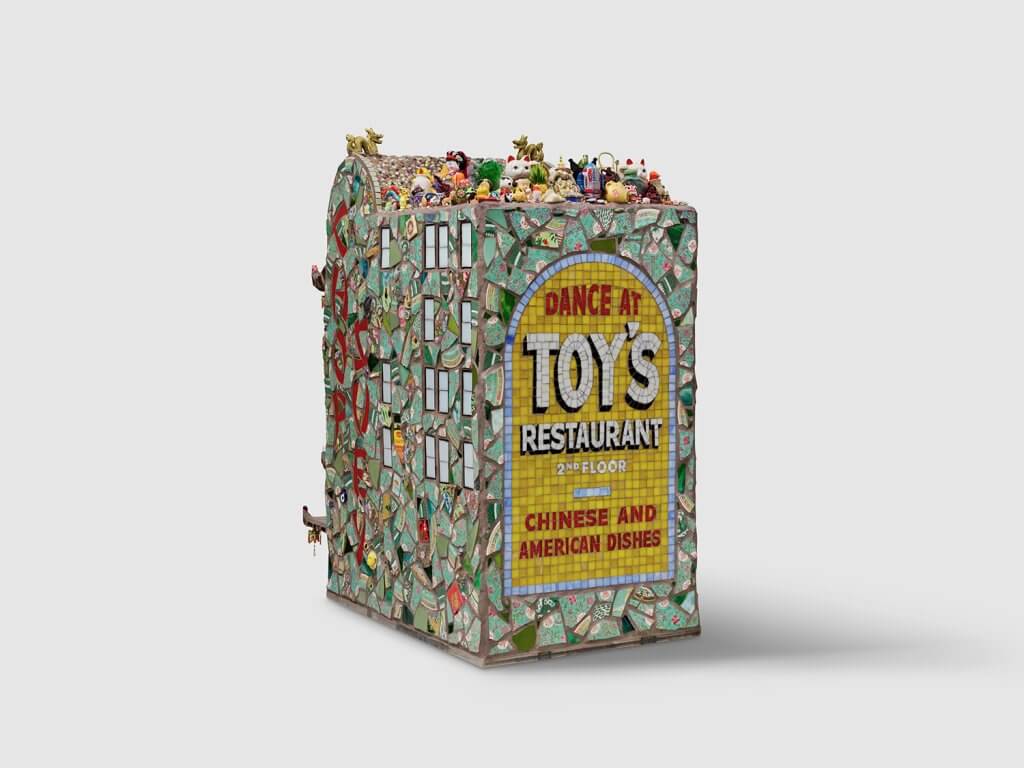
Stephanie H. Shih
Toy Building (Dream House), 2025
Chinese export porcelain, crowdsourced and found objects, archaeological ceramic fragments from a Chinese fishing village on Monterey Bay (c. 1850–1906), stained glass, polished stones, ceramic, glass rods, resin, enamel, and grout on ferrocement, polystyrene, and steel
51 x 25 x 45 in. (129.5 x 63.5 x 114.3 cm.)
Photo: Robert Bredvad
In 1883, a twenty-year-old Chinese immigrant named Moy Toy Ni arrived on boat to San Francisco. After a year of working on a potato farm, making two cents for every bag picked, he found work as a houseboy in the city’s wealthy homes, where he learned how to cook American and Chinese dishes. He dreamed of starting a restaurant, of making a living from his position between the East and the West, a position exemplified by his new, anglicized name: Charlie Toy. When Toy had saved enough for travel expenses, he went East to Chicago, then to Oshkosh, Wisconsin, where he started a small restaurant. The restaurant quickly became a bustling meeting place for businessmen, corporate executives, and elected officials, and by 1900, it had doubled in size. Toy added a gift shop, importing crates of goods like porcelain tea sets, silk fabrics, and other items imported from China. Within two years, Toy became the nation’s largest wholesaler of Chinese goods.
Toy’s story mirrors thousands of other Chinese migrants to the US, who hitched their lives to the exchange of goods and people between China and the US, and in the process created the beginning of what we might call today “Asian American culture.” In 1903, he purchased a building in Milwaukee’s Plankinton Avenue and found similar success in his new restaurant; his net worth was close to 4 million dollars (in today’s currency) just four years later. In 1913, he commissioned the architect R.T. Newberry to build a grand six-story building on North Second Street. The “Toy Building,” also known as the “Shanghai Building,” opened in March 1915 and was then considered the finest Chinese building in the United States. The sprawling, six-story Shanghainese restaurant also eventually featured a movie theater, a billiards hall, a ballroom, and clothing retailers. It was distinctive for its green terracotta tile, decorative lanterns, and golden dragons, and its success turned Charlie Toy into the “Chinese Rockefeller.”
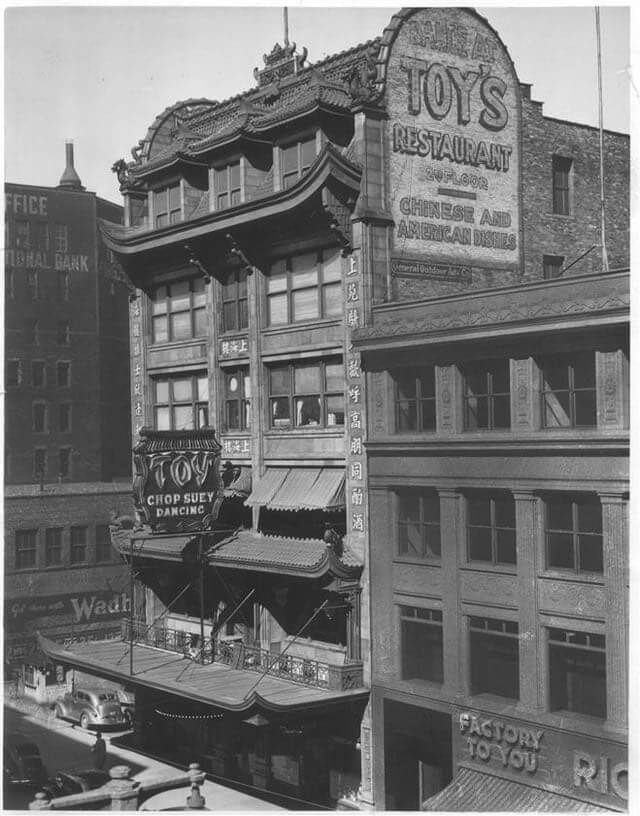
The Toy Building (1913-1939), Downtown Milwaukee, WI
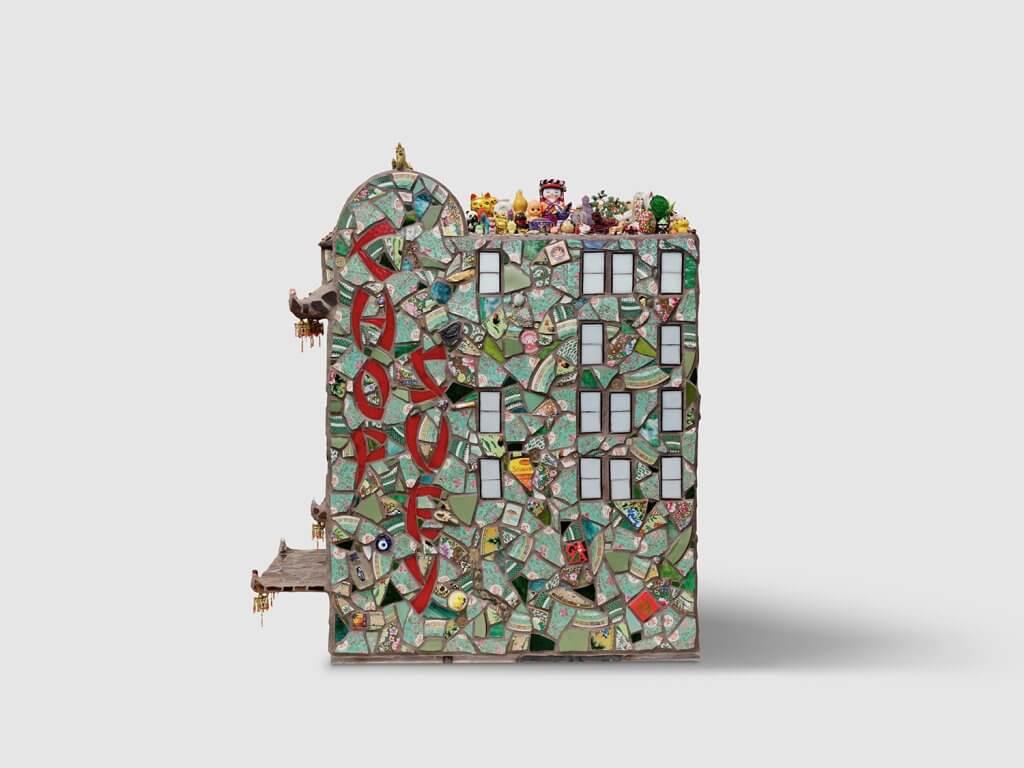
It is this history that Stephanie Shih’s Toy Building (2025) revives. While at a residency at the Kohler Co.’s industrial factory in Wisconsin, Shih was introduced to Jacob Baker’s Dream House (c. 1928): a concrete sculpture covered with rocks, glass, seashells, and found objects, both religious and patriotic. Baker’s Dream House is an iconic example of the Midwest Grotto tradition, first created in the early 1900s by European immigrants to the region. Shih’s Toy Building recreates a miniature version of Toy’s original building in the style of a Midwest grotto, a concrete house covered in shards of Asian porcelain, artifacts from the original building, and crowdsourced pieces of “Asian-adjacent” tchotchkes. In Shih’s Toy Building, it is as if the material history of Asian American life has risen to reconjure a long-lost building.
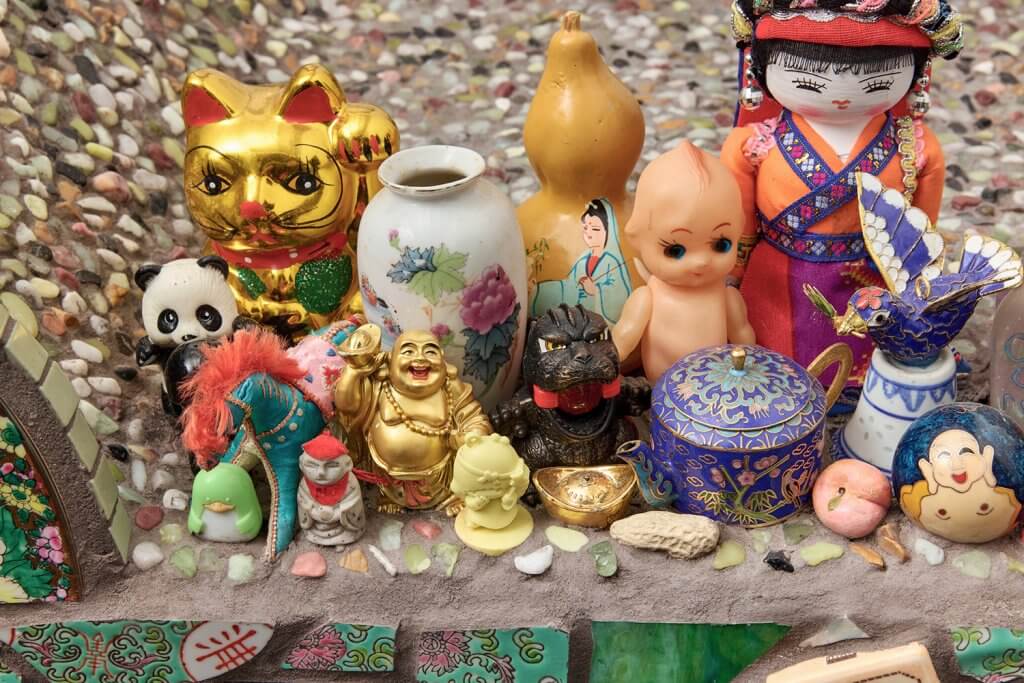
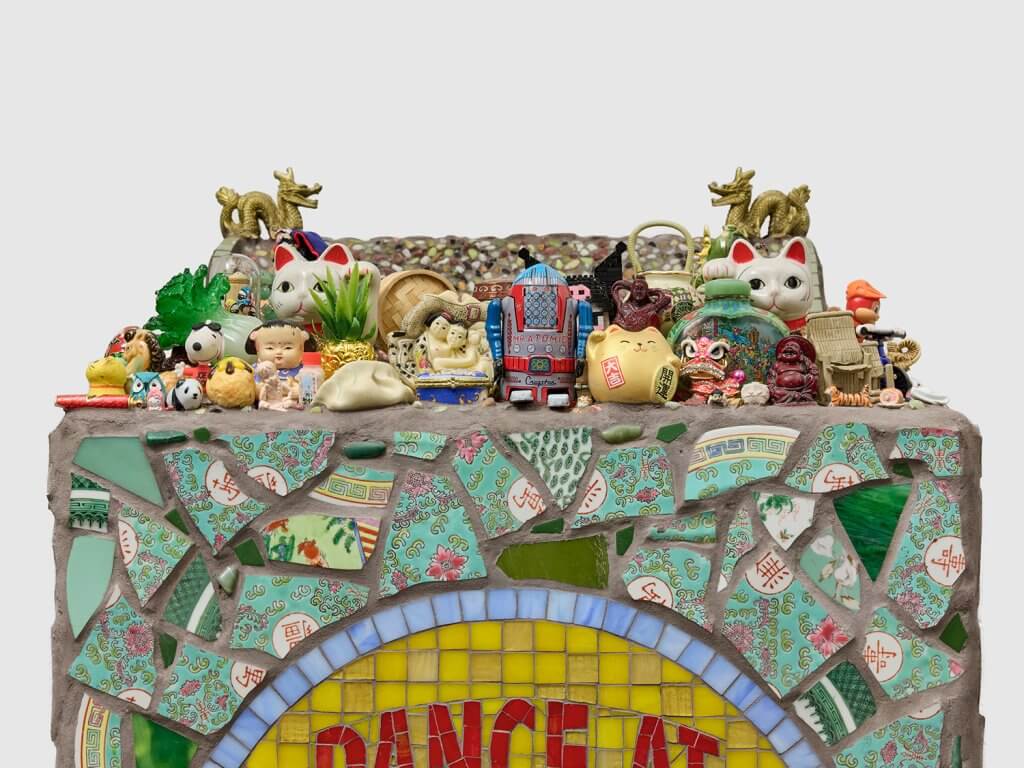
A closer look at Toy Building’s surface reveals a mosaic of commodified Asianess: forks from Japan Airlines, pale green shards of Jingdezhen porcelain, ceramic fish, cute Sanrio characters, and a nazar amulet. A magnet that just says “Mongolia.” In one particularly striking object, a Japanese woman in a kimono melds into the tines of a comb, like an equal sign: Asian woman = commodity. The depth and variety of materials attest to the fluidity of an already vague term like “Asian-adjacent,” but also to the inextricability of commerce to the notion of Asianness in the United States.
Stephanie H. Shih
Toy Building (Dream House), 2025
Chinese export porcelain, crowdsourced and found objects, archaeological ceramic fragments from a Chinese fishing village on Monterey Bay (c. 1850–1906), stained glass, polished stones, ceramic, glass rods, resin, enamel, and grout on ferrocement, polystyrene, and steel
51 x 25 x 45 in. (129.5 x 63.5 x 114.3 cm.)
Photo: Robert Bredvad
Shih crowdsourced most of these objects using Instagram in 2024, collecting over 100 submissions from the US and Canada, originating from East and Southeast Asia, Palestine, and the US. Shih also sourced objects from the two oldest American Chinatowns in San Francisco and New York, as well as some of her own ceramic work. Shih’s post echoes the grotto tradition of community sourcing but it also serves as an aggregate picture of what Asia looks like in the US; it is something as amorphous yet identifiable as the examples she gave in her post: “double gourds! zodiac animals! racist christmas ornaments! souvenirs from a vacation with your bad ex!” The toys carry memories: some of painful racist caricature, others of personal significance. A particularly complex tchotchke that struck me is a Mr. Atomic toy, presumably a representation of an Atomic bomb over Japan, made into a “cute” figure. In Shih’s Toy House, these fragments are part of a continuous, negotiated history of images.
When the Great Depression came in 1929, Charlie Toy’s business was affected severely. Eventually, the landlords decided that a parking lot would generate more revenue than his ailing restaurant, and rather than try to buy his way out of the downturn, Toy sold his 99-year lease back to them. “Standing alone in the cold, unrelenting rain, Charlie Toy wept,” The Milwaukee Journal reported in 1939, “as he watched a wrecking crew demolish the beautiful Chinese-inspired structure he built.” Toy’s son convinced him to continue running a smaller restaurant on Second Street and a larger one in the heart of the theater district, and as he aged, he left the day-to-day operations to his son and traveled back to China, where he lived for the rest of his life before he died in 1955.
Stephanie H. Shih
Toy Building (Dream House), 2025
Chinese export porcelain, crowdsourced and found objects, archaeological ceramic fragments from a Chinese fishing village on Monterey Bay (c. 1850–1906), stained glass, polished stones, ceramic, glass rods, resin, enamel, and grout on ferrocement, polystyrene, and steel
51 x 25 x 45 in. (129.5 x 63.5 x 114.3 cm.)
Photo: Robert Bredvad
Shih keeps some aspects of the original building––the iconic windows, the green hue, the miniature lanterns––but modifies others––enlarging the sign and expanding the text on the surface (in translation: “At the sea pavilion, cultured guests rejoice in meeting kindred spirits and admiring famed flowers / In the upper garden, crowds cheer and fine friends drink together”). Shih’s Toy House also leans into the synergy between the Grottos and Asian shrines, with various little “gods.” There is a Hello Kitty in a warrior suit, cats, dogs, and animals of Chinese mythology, a Badtz Maru and other Sanrio characters, golden pineapples, and jade lettuce. They sit on top, as if they were new-age guardians, holding court over a building––and a moment––that has passed away.
Perhaps Toy’s story, and Shih’s revival, plumb the true conditions of what makes a home: something accreted over time, an attempt to make whatever you have more comfortable than what it is. America. Some of the objects Shih received originated in Palestine, a reflection of her activism there, amidst the horrors of an ongoing genocide. Today, we might question Toy’s entrepreneurialism, his readiness to make a living feeding a market of orientalised goods. We might see the conditions of his struggle as part of a spectrum of American colonial violence and racism that extends to Palestine. Yet we might also see Toy as a survivor; the backbone to Shih’s house: a fractured, multivalent snapshot of what it means to be Asian in America in 2025.
Stephanie H. Shih
Toy Building (Dream House), 2025
Chinese export porcelain, crowdsourced and found objects, archaeological ceramic fragments from a Chinese fishing village on Monterey Bay (c. 1850–1906), stained glass, polished stones, ceramic, glass rods, resin, enamel, and grout on ferrocement, polystyrene, and steel
51 x 25 x 45 in. (129.5 x 63.5 x 114.3 cm.)
Photo: Robert Bredvad
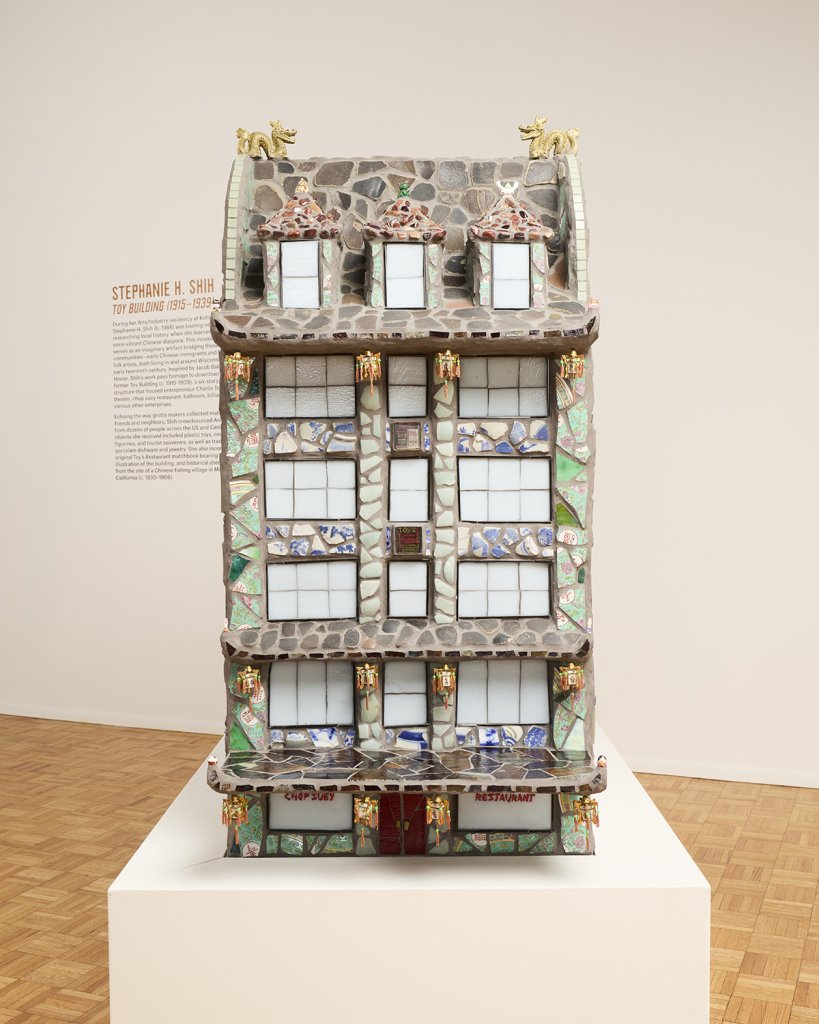
Installation view of A Beautiful Experience: The Midwest Grotto Tradition (June 7, 2025–May 10, 2026) at John Michael Kohler Arts Center, Sheboygan, WI. Courtesy of the John Michael Kohler Arts Center.
Simon Wu is a writer and artist. His first book, Dancing On My Own, was published by Harper Collins in 2024. His writing appears in The New Yorker, The Paris Review, Bookforum, and The Drift, among other venues. In 2021 he was awarded an Andy Warhol Foundation Art Writers Grant and was featured in Cultured magazine’s Young Curators series. He is a member of the Racial Imaginary Institute, was a 2018 Helena Rubinstein Curatorial Fellow at the Whitney Museum Independent Study Program, and is currently in the PhD program in History of Art at Yale University.
Stephanie H. Shih (b. 1986, Philadelphia, PA) has exhibited work at James Cohan, New York, NY; Jeffrey Deitch, Los Angeles, CA; Berggruen Gallery, San Francisco, CA; Alexander Berggruen, New York, NY; Cantor Arts Center, Stanford, CA; Berkeley Art Museum and Pacific Film Archive, Berkeley, CA; Santa Barbara Museum of Art, Santa Barbara, CA; Bradbury Art Museum, Jonesboro, AR; and the American Museum of Ceramic Arts, Pomona, CA. The artist has also been the recipient of numerous awards and residencies including the Pollock-Krasner Foundation Grant; NYSCA/NYFA Artist Fellowship, New York, NY; residency at The Corporation of Yaddo, Saratoga Springs, NY; Arts/Industry Residency at John Michael Kohler Arts Center, Sheboygan, WI; and a grant from the American Museum of Ceramic Arts, Pomona, CA, among other accolades. Her work is included in the collections of the Santa Barbara Museum of Art, Santa Barbara, CA; Bowdoin College Museum of Art, Brunswick, ME; Cantor Arts Center, Stanford, CA; and Middlebury College Museum of Art, Middlebury, VT, among other institutions. She will be included in forthcoming institutional exhibitions at Christopher Newport University, VA, and the John Michael Kohler Arts Center, Sheboygan, WI. Alexander Berggruen represents the artist.
Community work is central to Shih’s practice, and since 2017, she has used her art and platform to raise over half a million dollars in direct aid for victims of state violence. She is currently based in Brooklyn, New York.
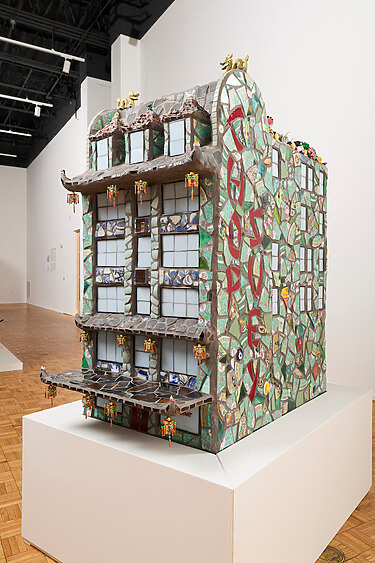
Installation view of A Beautiful Experience: The Midwest Grotto Tradition (June 7, 2025–May 10, 2026) at John Michael Kohler Arts Center, Sheboygan, WI. Courtesy of the John Michael Kohler Arts Center.
